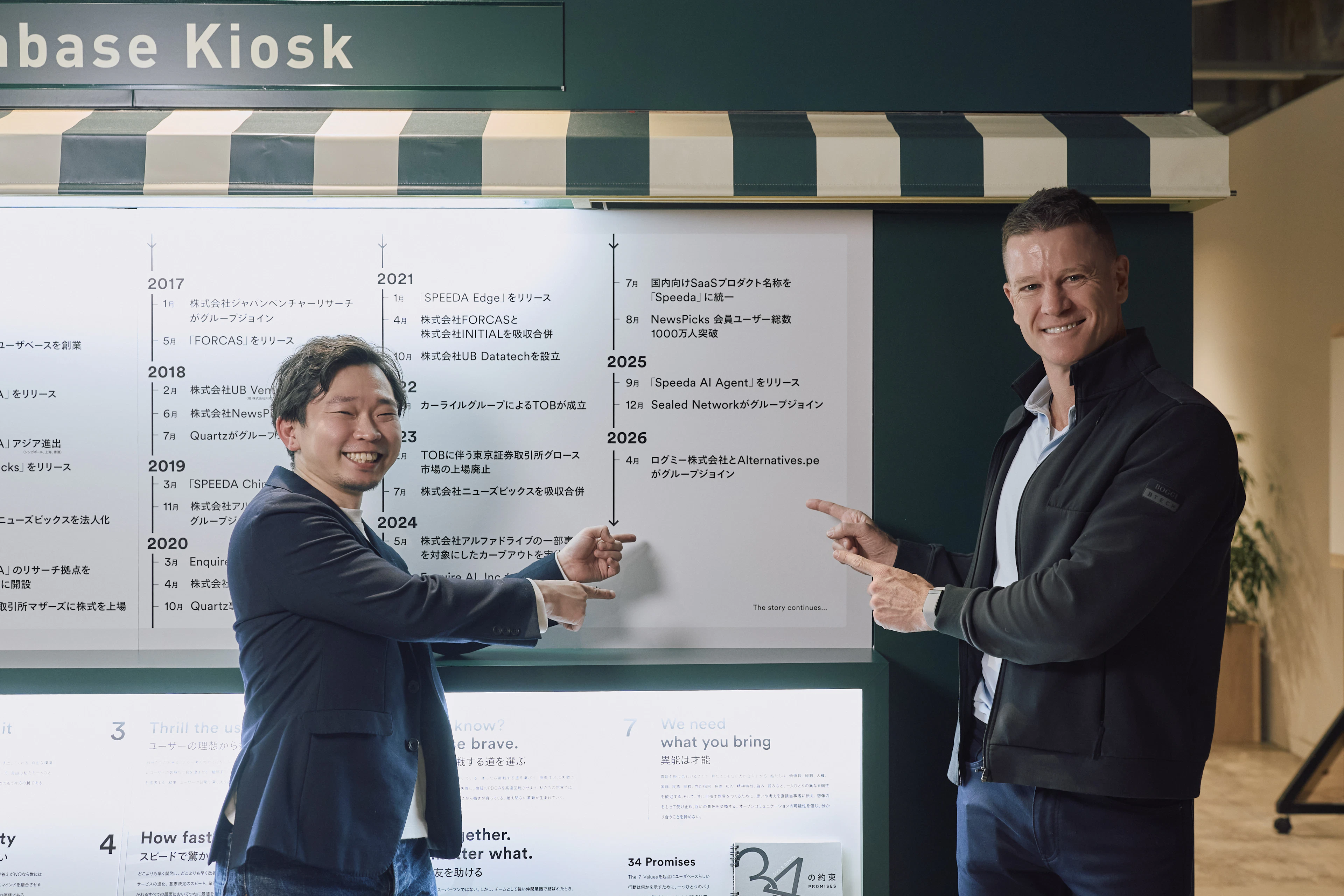


The "Information Gap" in Private Markets: A Story Rooted in Personal Experience
Jason Edwards (hereinafter "Jason"): When I was working in private equity and later when I set up a VC fund, I felt intense frustration at not being able to find a database with accurate and comprehensive financial information on startups and other private companies.
I tried other data platforms, but what I found there was essentially just information that anyone could find on the web. From my experience working as a lawyer, I knew that by drawing on regulatory filings, it would be possible to provide far more accurate and comprehensive information. That's where the solution to the problem lay.
Jason: At the time, the data providers in the market all had similar kinds of information, but it was unreliable, neither comprehensive nor accurate. Most of it was based on web crawling or self-reported data from companies.
The real challenge—the gap that existed in the market—was to provide something more robust and trustworthy. Investors need accurate, detailed, and comprehensive information to make the right decisions. But that simply didn't exist in Southeast Asia. And as far as we could see, the situation was the same across the rest of Asia, with the exception of Japan.

Jason: The importance of data is only growing. Especially in the world of finance and investment, data is absolutely indispensable.
I have what you might call a fanatical obsession with data accuracy. Because if you're providing inaccurate financial information for investment purposes, what exactly are you doing? You're simply offering something that anyone else could get by crawling the web and aggregating the data themselves.
That's why it was so important to give people access to something of much higher quality. We wanted to offer a completely different level, a completely different source—something that had never been seen before in Southeast Asia or Australia. The goal was to let people see information about private companies at a level as close as possible to the disclosures made by publicly listed companies on a stock exchange.
Why Uzabase? The Deciding Factor in Choosing a Partner
Jason: In 2022, I reached out to Speeda. At the time, we had already started licensing our data to several major data providers, and we were keen to license to Speeda and Uzabase as well.
Through a mutual acquaintance, I was introduced to Tomo (Tomoyuki Ota, Senior Executive Officer, Business Development), and he tried out our platform with a few members of the SPEEDA team in Singapore. He was very impressed with our data, but at that point he shifted the direction of the conversation and saw a much bigger opportunity.
Jason: Yes. He expressed much stronger interest in the possibility of collaborating with or acquiring our company in the future, rather than simply licensing data from us. It was a very interesting conversation—surprising and exciting at the same time. That was our first discussion.
Over the following three years, I met with Tomo every time he came from Japan to Singapore. We built a strong relationship, and I developed a deep respect for Tomo and the other Uzabase members I met along the way. I was genuinely excited by their approach to becoming the leader of private market insights across Asia. That's how we first connected.

Jason: I'm convinced it was the right choice. We are very strongly focused on Asia—particularly Southeast Asia, where we started our business. We've also expanded into Australia, and we're looking to grow into India and other parts of Asia going forward. Uzabase is also very strongly focused on Asia.
Jason: Yes. There are many synergies and overlaps in our businesses, but they exist in a very complementary way. Compared to any other data provider, we felt a much stronger affinity with Uzabase.
I was also deeply impressed by the people I met at Uzabase. If I was going to sell my company, I felt that this was the right organization—one where I'd want to be part of it myself in order to take things to the next level. And since I love Japan and Japanese food, it was the perfect solution for me.
Ryohei Osawa (hereinafter "Osawa"): What truly impressed me was the level of discipline they showed in deeply understanding the needs of their users—investors—and their commitment to building a high-quality dataset from scratch to meet those needs.
In that moment, I thought: there's actually a company in Asia that is doing exactly what we at Speeda are striving to achieve! I was genuinely thrilled, and that excitement hasn't faded.
Uzabase has set out a vision (*) to become Asia's #1 economic information infrastructure. Through Speeda, we want to make startups more accessible and create a world full of challengers. This partnership aligns strongly with that vision, and I'm confident we can accelerate our growth together at the fastest possible pace. I'm truly looking forward to what we'll build together.
This vision is set out as VISION2028, with a target horizon of 2028.
Jason: I've been impressed by how professional, organized, and fast Ryohei and his team are. It reminded me of one of Uzabase's values: "Wow fast"—and I'm experiencing that firsthand right now.
It's very exciting to see things moving at such speed. At the same time, the support has been outstanding. You can really feel that the Uzabase team genuinely wants to help us grow faster and stronger. "Stronger together"—that's exactly it. I feel increasingly positive about the decision to become part of Uzabase. I'm very glad to be here.
Osawa: As I mentioned, I'm just incredibly excited right now. Over the coming years, through this integration, we aim to help more people access accurate information and make faster, better decisions. There's a lot to do, but we will make it happen.

Jason: For me, I'm excited to be part of such a professional and forward-thinking organization as Uzabase, and to work together to build a global leader in Asian insights.
Uzabase is clearly the market leader in Japan and a key source of information across other parts of Asia. By combining our deal data with Uzabase's highly detailed financial data and other data on Southeast Asia, I believe we will become an even more dominant player in the region.
And our complementary skills and experience should help us expand into other parts of Asia and become a top player there as well. Working with Uzabase, I believe that we can become the market leader in Asian insights.
At the same time, I feel a little daunted—because many people are expecting us to achieve a great deal. The bar is high. But that's exactly why we're determined to deliver and give everyone what they want to see. We're ready to start that process and work together to reach our goals.
The Future of Asia's Economic Information Infrastructure, Shaped by Integration
Jason: Southeast Asia is a massive market of approximately 700 million people, home to some of the countries with the highest GDP growth rates in the world over the past several decades, and growth is projected to continue. This presents an immense opportunity for investment.
But investment requires careful, data-driven decision-making. As a result, the number of people seeking reliable, robust data will only continue to grow. As part of Uzabase, we believe we can provide the best data source for investors and advisors to make those decisions. As Southeast Asian markets grow, demand for data will keep expanding.

Jason: By combining these two datasets, users will have access to the best financial data that Speeda has to offer, together with the best deal data that Alternatives.pe has to offer. When integrated, this will be the best private market data source in the regions we cover. Once we become one, nobody will be able to stop us!
Jason: This partnership brings very positive benefits for both existing and new users. Not only will they gain access to the best deal data available, but they'll also be able to leverage the remarkably detailed financial information that Speeda provides. When these two datasets are combined it will be way ahead of anything in the market.
Jason: Absolutely. I think the first step is to understand the market by looking at the data we already provide on startups and other private companies in Southeast Asia and Australia.
Using our data, you can understand what companies exist there, at what valuations, what their financial situation looks like, and where the opportunities are to invest in or collaborate with them.